


Car import · Switzerland
Importing a car from Switzerland in 2026? Here’s what you need to know
Importing a car from Switzerland can be a smart move in 2026, but it works differently than importing from, say, Germany or Belgium. Switzerland is not part of the EU. That means you’ll be dealing with customs clearance, VAT, possible import duties and BPM (Dutch vehicle registration tax).
The most important tip? Calculate the full import costs before you buy, and check that all the required documents are in place. That way an attractive Swiss deal doesn’t end up costing more than expected.
Importing a car from Switzerland: the key rules
Importing from Switzerland almost always involves customs, VAT, BPM and registering the vehicle in the Netherlands. Switzerland is located in Europe and is a member of EFTA, but it is not part of the European Union. Similar principles apply as when importing a car from another European country outside the EU.
In short:
- ✓The car must be exported from Switzerland.
- ✓On entering the EU, the car must be declared to customs.
- ✓You pay Dutch VAT on import.
- ✓You may owe import duties.
- ✓BPM may be due for registration in the Netherlands.
- ✓The car must be registered with the RDW (Netherlands Vehicle Authority).
Because several tax and administrative steps come together, good preparation really matters.
Why import a car from Switzerland?
Switzerland is especially interesting if you’re looking for something distinctive, luxurious or richly equipped. The range on offer differs from what you’ll typically find on the Dutch market.
Think of premium models, special trim levels, specific factory options, youngtimers and classic cars.
That doesn’t automatically mean every car from Switzerland is cheaper. The purchase price is only one part of the total cost.
Want to first find out whether Switzerland is worth exploring for your search? Then also read 7 reasons to import a car from Switzerland.
How much import duty do you pay on a car from Switzerland?
For a passenger car from a country outside the EU, the import duty is usually 10%, but that isn’t necessarily the case for a car from Switzerland.
Import duty is calculated on the customs value. This looks at more than just the purchase price alone — transport and insurance costs up to the EU border can count as well.
Sometimes you pay less duty, or none at all
Switzerland has trade agreements with the European Union. As a result, a vehicle with the correct preferential origin may qualify for a reduced import tariff, or even 0%.
To claim this, the origin of the vehicle must be properly proven with the right proof of origin.
How does VAT work when importing from Switzerland?
Because Switzerland is outside the EU, you’ll in principle pay 21% VAT on import into the Netherlands.
This VAT isn’t calculated on the purchase price alone — import duties, among other things, can also form part of the base on which import VAT is calculated. As a result, these costs reinforce each other.
A car that looks a few thousand euros cheaper in Switzerland isn’t necessarily better value once you add everything up.
And what about Swiss VAT?
The standard VAT rate in Switzerland is 8.1% in 2026. Under certain conditions, this Swiss VAT may not be due on an export sale. To qualify, the export from Switzerland must be properly documented.
So before buying, ask the seller:
- Is the sale price inclusive or exclusive of Swiss VAT?
- Can the car be sold as an export sale?
- Which export documents are needed for that?
- How is a possible refund handled?
Don’t assume you can always reclaim Swiss VAT. That depends on the sale situation and the approach chosen.
Do you have to pay BPM when importing from Switzerland?
When registering a passenger car in the Netherlands, BPM (Dutch vehicle registration tax) often still has to be declared. How much BPM you ultimately pay depends heavily on the vehicle.
Among other things, the following factors play a role:
- CO₂ emissions
- Date of first registration
- Age of the vehicle
- Original BPM amount
- Depreciation method used
For a used car, depreciation can be taken into account. As a result, the remaining BPM can be considerably lower than for a new car.
For passenger cars and motorcycles aged 17 years and 10 months or older, no BPM is due at all on import.
Want to know roughly what to expect beforehand? Have a BPM calculation made before you buy.
What does it cost to import a car from Switzerland?
The total import price consists of far more than just the purchase price of the car. Always look at the full cost price in the Netherlands.
✓ = fixed cost item · ● = depends on your situation
- ✓Purchase pricefixed
- ●Transport from Switzerlanddepends
- ✓Export and customs documentationfixed
- ●Any import dutiesdepends
- ✓21% import VATfixed rate
- ●BPMdepends
- ✓RDW registrationfixed
- ✓Licence platesfixed
- ●Any additional servicesdepends
Say two comparable cars cost €40,000 in the Netherlands and €34,000 in Switzerland. At first glance, the Swiss car looks €6,000 cheaper.
Only once transport, import duties, VAT, BPM and registration are factored in do you know whether that price difference actually holds up. Want an early indication of the transport cost? Calculate it directly with the car transport cost calculator.
Which documents do you need?
Make sure the key documents are arranged before the car leaves Switzerland. Missing documents can delay customs clearance or Dutch registration.
Depending on the vehicle and the situation, you’ll need, among other things:
- ✓Purchase invoice or sales contract
- ✓Original Swiss registration document
- ✓Export declaration
- ✓Vehicle identification number (VIN)
- ●Possibly a Certificate of Conformity (CoC)
- ●Possibly proof of origin
- ●Other vehicle documentation
Want to make use of a preferential import tariff? Then the proof of origin is especially important.
Arranging this after the fact can be more difficult. So check before buying which documents the Swiss seller can provide.
Drive it to the Netherlands yourself, or have the car transported?
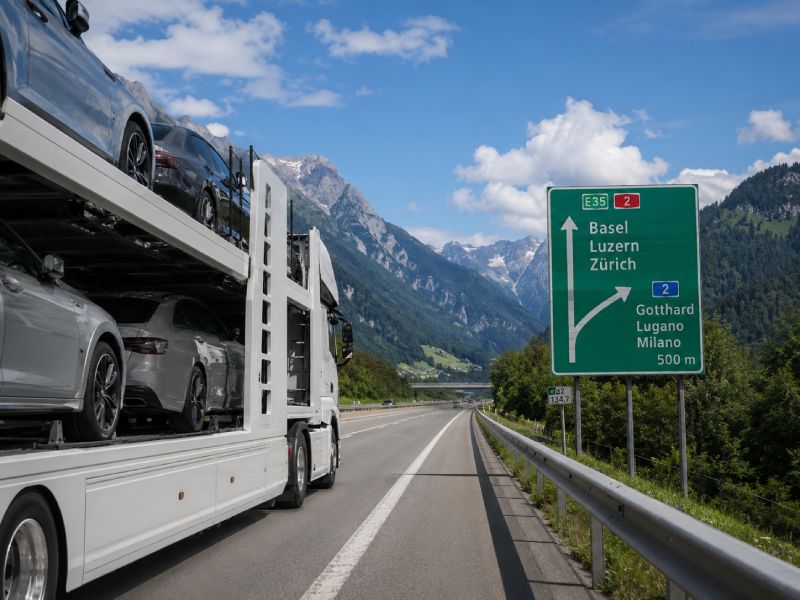
Both are possible, but transport by car carrier means you don’t have to arrange export plates and transport to the Netherlands yourself.
A car can, for example, be exported from Switzerland using export plates. You can also have the vehicle transported.
Which solution is most practical depends on, among other things:
- The location of the car
- The value of the vehicle
- The documents available
- The condition of the car
- How much of the import process you want to arrange yourself
For exclusive cars, classics or vehicles that can’t be driven right away, professional international car transport is often the practical choice.
How do you get a Dutch licence plate?
After customs clearance, the car must be registered with the RDW and any BPM declared before the Dutch licence plate can be issued.
Switzerland is a member of EFTA. For the RDW, a vehicle from Switzerland therefore falls under the procedure for importing a vehicle from an EU or EFTA country.
During the RDW inspection, the RDW identifies the vehicle and assesses the accompanying documents. Once the vehicle data has been processed, the BPM declaration can be finalised.
Once the RDW and the Dutch Tax Administration have given their approval, the Dutch licence plate is issued.
Importing a car from Switzerland in 6 steps
In practice, importing a car consists of six key steps.
Find and inspect the car in Switzerland
Calculate the total import cost in advance
Arrange the purchase and the required export documents
Transport the car to the Netherlands and arrange customs clearance
Have the car registered with the RDW and file the BPM declaration
Arrange the Dutch licence plate, plates and insurance
Steps two and three are especially important. Misjudging the import duties, BPM, or the documents available can lead to unexpected costs later on.

Common mistakes when importing from Switzerland
Most unpleasant surprises happen because people only work out what the import actually costs after they’ve already bought the car.
So watch out especially for these common mistakes:
- ✕Comparing only the Swiss asking price
- ✕Not having a BPM calculation done
- ✕Assuming 0% import duty always applies
- ✕Trying to sort out the proof of origin only after the fact
- ✕Not checking how Swiss VAT is treated
- ✕Not paying enough attention to export documentation
- ✕Arranging transport and customs clearance too late
Good preparation not only prevents extra costs, it can also speed up the import process considerably.
Is importing a car from Switzerland worthwhile in 2026?
Yes, especially if you find a car whose trim level, condition or price is clearly more attractive than what’s available in the Netherlands. But the purchase price alone doesn’t tell the whole story.
So before you buy, calculate:
Only once you compare that full total with the Dutch market price will you know whether importing from Switzerland is financially worthwhile.
The rates and rules mentioned can change and depend on your personal situation. This article is intended as general information and does not replace tax or legal advice.
See here how we can help you with importing a car from Switzerland.

Marlog Europe guides you through the customs clearance, international car transport and registration of your Swiss purchase, and holds AEO certification. That means we work according to recognised, carefully managed customs processes, contributing to a reliable and smooth handling of your import.